Saturday, December 03, 2011

Arse sliding

Valdivia :: Chile


Where else can you climb a volcano and expect half a cow on a BBQ when you get home?


Places: Pucon & Valdivia.


Coolest thing I did: Spent 4 and a half hours climbing a volcano and then sliding back down it on the snow in about 30 mins.


Coolest thing I didn´t know: There is a wine grape here called Carmenere that came from France but has been extinct there for 150 years or so and now only exists in Chile.


Now I feel like I'm on holiday. Even though Pucon turned out to be a small alpine town that totally exists to cater to the tourists it was probably the highlight of Chile thus far. The day we got off the night bus was under a perfect blue sky and you could see the snow covered cone of the Villarica volcano at the end of the street, complete with billowing funnel of smoke. It seriously looks like one of those volcanoes that you draw as a kid, a cone with a flat top and smoke coming out, a kind of Platonic form of volcanoes, and pretty soon you discover the number one reason everyone is in town is to climb it.


You also discover pretty soon that these people are not mucking around. You get up at 6am to start the climb and you pretty much have to take all their equipment, including down to the boots unless you've prepared and brought serious shoes yourself. When you open your pack and see spikes, several layers of waterproof gear and an ice pick you know you're not in for a leisurely climb. It's about 5 hours from the car park to the crater but 4 hours of that is through snow on a slope that they use for a black run when the volcano hosts a ski resort in winter. There is also an option to skip the first hour by taking a chairlift up, but out of our group of 12 the 5 youngest and stupidest men decided that would be cheating and decided to walk up that bit too. Funnily enough, once the first one said he'd climb it my man brain took over and I had to as well.


So I've been up volcanoes before, but I've never climbed a snow covered mountain ever and it is really hard going. I did manage to keep up with the front runners the whole way (marathon training may still be paying dividends) but by the time we reached the top I was really feeling the lack of exercise since September. Having said that the views in every direction were amazing, you can see several other volcanoes in each direction and have a lovely photo to take over the town of Pucon with the lake it rests on. That alone would have been worth it, but the ride down made me think I'd nearly have done it all again the next day.


One of the things they put in your pack I've christened the arse slider, because I can't remember what the Spanish name for it was. It's basically a bum sized hard plastic seat with a handle on the front which goes between your legs and you simply point both your feet to the ground and let gravity do the rest. You end up soaked to the bum and with a heap of snow in your face but it's heaps of fun.


The only way you could top that was this kid from Colorado who climbed up with us carrying a rented snowboard. I had jokingly said to the guide it would be awesome to ride a board down and he was quite serious when he said they'd rent me one if I carried it up myself. One look over the East face of the mountain (we slid down the much shallower North face, but the snow was far too messy to board down) told me I'm nowhere near a good enough boarder to have taken that on. This guy just disappeared and I don't think he touched either edge into the snow for a good 100 or 200m directly down. Maybe next time.


So how do you top that? Well the next day the call was made to try hydrospeed, which is the stupidest name for a sport ever. Basically you take these massive fat foam body boards with arm holes cut into them and go down rapids. You know, because doing that in a boat doesn't get you close enough to submerged rocks with your face. We had a very good guide who was good at showing us the right way to go to not end up underwater and despite a little bit of bashing each other over the head with the boards and kicking each other in the fact with our fins it's also never feels at all dangerous. Everyone ended the hour and a half with a massive grin on their face and I would strongly recommend it as an activity if you're ever anywhere with a river fed by melting snow. The water should have been freezing, even in a wetsuit but you're moving so much you hardly feel it.


So while most parts of Chile I've been travelling in are known for their seafood the Chileans like nothing better than a good BBQ, or Asado as I've found out they're called. For the first time in years I've actually fallen back in love with hostel life again and last night's Adsdo was a big contributor to that. I ended up in a place called El Refugio, run by a Dutch guy that's never going back and the atmosphere in the place was such that everyone felt at home and there was always a big group to share a litre of beer or just talk crap with. We invited a few of the travelling companions that have been picked up along the way who were staying in other places in Pucon and they all said they felt a different vibe. I suppose these days most of the hostel kids spend all their time on Facebook at nights so it's good to have that family feel hostels used to have before wifi. Sorry, grumpy old backpacker rant over.


So an asado is a BBQ cooked over charcoal and the staples are Chorizo hotdogs and big slide of beef simply cut into inch thick strips and handed around. Add to that we'd all chipped in for enough beer and wine to keep us going from about 7pm to midnight and it made for a messy night. I think that one night alone furnished the travelling group with quite a few recruits for Christmas at the bottom of the world, which looks like the current plan.


So a short, hungover bus ride has me sitting in Valdivia, and unfortunately due to it chucking it down rain outside I'm sitting inside writing this. I've had a constant travel companion who I met on the way from the airport to the hostel in Santiago from Perth, James who has been happy enough to let me dictate travel plans thus far, but he easily talked me into stopping off here to drink at the Kuntsmann brewery, which so far has been easily one of the better beers I've sampled in Chile. That's on tonight so at least if the weather ends up repeating itself tomorrow I can spent some quality time sleeping. After that it's over the boarder for the first sneaky trip into Argentina to Bariloche, which I'm still yet to hear a bad word about.


If the beer is called Kuntsmann it might also explain why everyone in this room seems to be speaking German. And is on Facebooking on their computers and ignoring each other.


As a side note I met this guy in Pucon who has been riding his motorcycle from Toronto to Tierra del Fuego (via Alaska for the hell of it). Check out the website as it's truly an awesome feat.
Tuesday, November 29, 2011

Whose house?!?

Valparaiso :: Chile


Pablo's House!
"I am familiar with the works of Pablo Neruda" - Bart Simpson


Places: Santiago, Valparaiso & Quintay.


Coolest thing I did: Wandered the old streets of Valparaiso's hills, where it seems like every space is a blank canvas.


Coolest thing I didn´t know: Back in the olden days, I'm guessing sometime before they invented TV, you could become a national hero AND be loaded at the same time, just for being a poet.


So the grand Sudamerica tour starts in the Chilean capital of Santiago, which even after a few days doesn't feel like it's crammed to the gills with tourist sites. It's fairly easy to get a few under your belt in the first 48 hours (even with massive jetlag) and then you don't feel like you're slacking off when you're sitting out on the footpath tables on Pio Nono in Barrio Bellavista, where the student bars will see you a litre of beer for $3, or $4 if you go to one of the posh ones that use glasses rather than plastic cups. The feeling I got from Santiago is it was a far better city to just hang about in than to be a hard core tourist - which was a nice gentle start to 6 months of mangling the Spanish language.


Walking around Santiago's main centre you get the feeling that there was a country here once, with a colonial history that's just been totally overshadowed by the 1973 coup organised by one General Augusto Pinochet. You can't see inside the presidential place, mostly because the President lives there, but that was also the site of the overthrow of a bloke called Salvador Allende, who was elected president, but also a communist, which back during the cold war was a fairly good way to end up in a coup. The army shelled the presidential palace, Pinochet took over with material support from the CIA, Allende ended up dead from suspicious suicide and Chile got the kind of repression you only really get from a right-wing military dictatorship. The weirdest result of the coup is the fact booze is really cheap and books are really expensive in Chile, even to this day. It does explain everyone's really impressive alcohol tolerance.


One thing worth at least seeing for it's total wrongness in the commercial downtown of Santiago is Cafe con piernas, which seems to be a stand up coffee bar where businessmen and old blokes with nothing better to do but read the paper all day are served coffee by girls in short skirts and high heels. I can imagine back in the day there was just one of these places, with someone's sister serving coffee with her ankles showing and then a kind of hemline arm's race ensured so now the girls where something that could best be described as "a thick belt". I can imagine the longevity of a place like that in Sydney's CBD.


Santiago has two hills with parks on top of them that you climb to get a view over the city, which is a nice thing to do on a day when the smog isn't too thick. The one to do is Cerro San Cristobal, which has the bonus of being much higher and having a statue of the Virgin Mary at the top to be photographed next to. In my first the hell with you, Lonely Planet moment of the trip (I expect many more) it seems like going the back way to take the cable car doesn't work since the cable car stopped working about 2 years ago. I did climb up for a couple of hours, passing wrecked looking cyclists riding up and being side-swiped by wild eyed cyclists tearing it down the other way. The easy way up would have been to take the funicular which left from about a block from where I was staying, but who does it the easy way? I was lucky with how far I could see, and it seems like Santiago is a massively flat city, except for the few places massive hills with nothing built on them punch through.


Really, the best thing to do in Santiago is to go between cafes and wander the streets of Lastarria & Bella Artes and spend the nights tearing up the bars and night clubs. My big Friday night out ended up being so massive that the next day when I walked past the bar we started in the staff shook my hands and I had no idea who most of them were. I have vague recollections of being a nightclub at some point and woke up at 2pm on Saturday, which I blame on the jetlag. This is a object lesson in why you don't help a new mate you met on the plane over from Oz polish off 3/4 of a litre of duty free Bombay Saph before going out if you want total recall of the rest of the evening. G&Ts are apparently very good for fending off malaria I'm told, but I suspect more research will be required.


It might help if I ever lost my mind and decided to drink the chocolate milk coloured water of Santiago's main water way ("does this taste like cholera to you?"), which always seems to be flowing at a high pressure trickle. Perhaps that's why they've made the most logical use of a river running through the city, which is to put a park along it and then separate that park from the river with 3 lanes of traffic on each bank.


The segue between the towns of Santiago and Valparaiso are going to be the two houses of the poet Pablo Neruda, which I didn't think would be worth doing but both turned out to be highly awesome. The one in Santiago, called La Chascona after his mistresses' messy hair was kind of sprawling compound, where he could house 3 bars, a library and a study that I suspect used to have a view over all of Santiago before the high-rise came in. I like the sound of Neruda, who besides being knee deep in wives and mistresses over the years also had a few real jobs, like ambassador to Colombia and France. I'm not sure if poets could afford to have several massive houses in most countries back then, but I reckon most of them don't do that well now. Actually, he probably would have been a rapper these days so the houses would probably have been even bigger. It would also have more bling, but it's probably kind of hard to top having a Nobel Prize for Literature sitting out on your coffee table.


The house in Valparaiso sits near the top of one of the town's many massive hills you have to walk up to see anything interesting but has a view that would be priceless these days. It's modelled on a lighthouse, with lots of glass facing out to the Pacific on each side and each view is even better than the last. His study was on the very top floor, where he liked to spend his time not writing poems by using his binoculars to look for women sunbathing naked on their roofs. Apparently was common enough for him to do it all the time.


Valparaiso is a town to which earthquakes haven't been kind, which reminds you that Chile sits on the same ring of fire as New Zealand and Japan, except with more volcanoes. The flat part of the town down near the water has been recast with a grid and tends to look a bit down at heel and like Santiago has more than enough stray dogs wandering the streets. I've taken to naming them, and my record so far is a pack of six following me around. That time I only named the natural leader.


You could almost be put off by that part of town, except for the fact that it's either a back breaking climb or a ride on an antique funicular lift to reach the winding streets they've packed on to the hills, which has been converted almost entirely to an open air art gallery. It seems like it's cool to paint a mural on pretty much any flat surface and you can spend hours picking up where someone has painted a green woman in art deco, spray painted a stencil of Kurt Cobain or outlined light blue children escaping from the wall of a school. The layout of the streets is totally dictated by the geography, with sheer drops and steep climbs at the end of streets giving a view to the houses crawling over the next hill, or even better right out to the Pacific horizon. The town looks a bit like an Escher painting at times, and it may not be the kind of place you'd enjoy if you suffered a bit from Vertigo, but there's nothing like sitting on a terrace looking out over a sheer cliff to the port where the fish you're eating was landed that morning.


After an offer to split the hire car costs I spent yesterday between trying to learn about Chilean wine by going to vinyards on a Monday and eating fish in the tiny village of Quintay. The wineries we went to didn't seem all that interested in tourists, which struck me as strange, and wanted a fair bit of money for a fairly small sampling of their wines. We took one tour, of an organic winery, where they seem to try and make the grapes taste better via mumbo jumbo and magic. I assumed organic meant "we don't use fertiliser", not "we make our compost from herbs we bury along ley lines so they gain extra power from the earth". It was nutty. I liked the big commercial wineries wine better, but even then they seemed uninterested in us - it seems like it's just better for them to get bus loads of people on a weekend and not worry about people who show up in their car. It would have helped if any of the wine had been better than the Chilean stuff we've been buying in the supermarket at random, but it could also be because my science poisoned mind won't appreciate terroir based on the fact the peasants used to bury their grandmothers in the field where the grapes grown now.


I liked Quintay on the way back, we sat in a restaurant by the sea and ate seafood while watching some kid do very well at not stacking it into the massive rocks the waves he was body boarding on were crashing into. We also realised we'd be a 50/50 chance of making it back to the highway with the petrol we had remaining so we thought it best to ask in town. Apparently Senor Israel was the dude. You just keep asking people on the street for directions and pretty soon you come to Senor Israel's house, out the back of which he keeps 5 litre jugs of unleaded you can buy for 150% mark up. No wonder he seemed like such a happy old chap.


So this is me killing time before I get on a 12 hour overnight bus to Pucon, which is apparently the Queenstown of Chile.

Saturday, June 18, 2011

Plankers

Sydney :: Australia


Australia as a foreign country


Places: Perth, Exmouth, Denham, Monkey Mia & Coral Bay


Coolest thing I did: While swimming with the whalesharks is the big drawcard I actually think I liked swimming with the Manta Rays better. They move slower.


Coolest thing I didn´t know: You can pretty much drive as fast as you want in WA. We were getting overtaken doing like 130km/h on the highway.


We'll start with the postcards - Ningaloo Reef exceeded all my expectations. Situated 1200ish kms north of Perth is a couple of hundred kms of fringing reef which feels almost untouched when compared to the crush you can sometimes feel diving off Cairns or Townsville. There isn't much tourist infrastructure on the peninsula yet and that makes it feel a remoteness you can't get anywhere on the East Coast of Australia anymore. You come up here for the experience of swimming with the whalesharks, but there's just so much more than that to it - if it swam in the water I probably saw it over the course of a week. One day we were out diving and we saw humpback whales tracking along at about the same speed as the boat. On that same day dolphins decided to come right up to the hull and swim along with the boat as we charged out to the reef, as if it's something they do all the the time. You have to keep reminding yourself amidst all this blue sky and 29 degree days that it's the middle of winter.


The plan had always been to spend as much time diving out on the reef as possible, but on arrival it became obvious that the record highs of the Aussie dollar aren't doing very much for tourism in this part of the world. We only managed to get out diving on two separate days in the whole week, mostly because they have trouble filling up a dive boat at the moment. The plus side of that of course is you're going to be pretty sure there isn't going to be the kind of underwater traffic jams you get lining up for the Blue Hole in Egypt or diving off the pontoons in Cairns. Of the diving my favorite was the Navy Pier, which added to my limited diving on man-made structures and gave me my first night dive. I really have to get around to getting that Advanced license one of these days.


The Navy Pier is an accident of history. During the Cold War the Yanks decided that Exmouth would be a good place to put VHF antennae so they could communicate with their nuclear subs out in the Indian Ocean. Being Yanks, they also decided they should build these antennae (which are stories tall) in Texas and ship them out to Australia, but Exmouth being pretty remote they also had to dig a channel 14m deep and build a pier to unload them on. About 40 years later the reef has grown over it and it's become a favorite haunt of Grey Nurse Sharks and Wobbegongs. What's very unique about it is the fact you can drive right up to the pier in a minibus, get geared up and jump right in. Everything you want to see is quite shallow and 50 mins later you climb up a ladder like getting out of a swimming pool. All these massive diagonal struts are covered in new life and diving it by torchlight on the second dive added another interesting aspect to it all. Highly recommended.


The main reason anyone comes to Exmouth in winter is for the whalesharks, these big placid filter feeders who can be seen in several other places, but nowhere with the clock regularity of Exmouth between March and July. You can't dive with them, for the simple fact that they don't sit still very long, and you're only ever going to see them on the surface when they're hoovering up krill. When they dive, they dive deep and fast so being at 10m or so would be fairly useless anyway. It's quite a production as it is. You get on boats that go cruising around the reef waiting for light aircraft to spot the sharks and tell them where they are heading. This is possible because on a good day there's like 20m visibility under water and the things are massive - the biggest one we swam with was clocked at 6m long. You get geared up for snorkeling then the boat drops you off in front of where the whaleshark is heading and you kind of let it pass you and try your hardest to swim along after them. And it's not easy, they move at some speed and have a habit of turning at random however they do let you get within a few metres of them and you get a feel for just how big they are. I felt sorry for the flabbergasted backpackers we kept meeting who simply couldn't afford to do it while they were there, it was one of the highlights of the trip for sure.


Manta Rays are the other big beast you snorkel with off the back of a boat, and that was much easier to deal with due to it being far less popular. The same light aircraft tell you where they are going to be, but instead of charging along at top speed the mantas tend to just swim down a few metres and do backflips while they are feeding so you get to see right down into them as they do it. They truly are miracles of form following function, they just seem to open up like big sacks and stuff themselves with krill or whatever it is they are eating. Unlike the whalesharks there aren't that many rules around following them around so you can generally swim out there until you run out of energy.


On the peninsula the last town we stayed in was Coral Bay, which is pretty much a single street which faces onto what may well be the most attractive beach I've seen anywhere in this country, and I've seen a few. It's a long flat beach which is protected from fishing, meaning you can walk right down to the water, plug into your snorkeling gear and then drop off 3m or so into the water and then there's about 1km of reef right there. I saw turtles and sharks right off the beach, which is pretty rare anywhere else in the world. One day I was actually lucky enough to see a stingray swimming around in about half a foot of water while I was walking along the beach. There's so much life up there you don't even need to be in the water to see it apparently.


Fishing is a big deal in mid-WA and it seems to be the big dividing line between the "tourists" (ie, anyone who can't butcher their own roo) and the rest. Due to the massive amounts of money sloshing around over there most people seemed to be in a massive 4WD towing a huge fishing boat and were genuinely puzzled as to why anyone would be in this part of the world without either. More that one old grizzled man told us they remember a time not very long ago when Coral Bay was a bunch of shacks on the beach and they had wanted it to stay that way. Apparently because Coral has now got a hotel, a hostel and a few shops, which seemed to be a sign that the whole thing was now overdeveloped and ruined. I wonder what they'd make of Bondi. I mean when your town is like 80% caravan park by surface area it's hardly the Gold Coast.


The Western Austalians were an interesting bunch - it truly does feel like a different, far more prosperous country over there. Denham is the town you stay in when you go down to Monkey Mia to see the dolphins feeding on the beach, and it's a lovely one street town facing Shark Bay, however it knows it's target market. It's got a boat ramp about every couple of hundred metres and brand new covered sinks for cleaning all those fish you just spent all day catching. Our neighbours in the motel were an extended clan of mining types from Karratha down on holiday to do some fishing and driving around in 4WDs. One look at the rental car (a Lancer, which after a 500km drive south from Exmouth had collected some kind of little bird in the grill) and we pretty much dropped heavily in the estimates of all the menfolk. With hindsight there is a lot of Shark Bay you can't see in a normal car, but they were more perplexed by how we were going to go fishing without a boat. The womenfolk, however, seemed OK with us, though the matriarch of the clans rambling story about how she never understood how e-tags work after her one trip to Sydney pretty clearly illustrated we're a different race from them.


On a pretty perfect morning we drove the 20-odd kms from Denham to Monkey Mia to see where the dolphins come in to feed and though I'd seen it before on TV, there's nothing like dolphins swimming right up to you in knee deep water because they're hungry. The rangers are pretty controlled in how many fish they are allowed to give out so there's a bit of jostling to get in a spot where you get to be one of the lucky few. I tended to get annoyed when old people got to do it instead of little kids - you had your life already, let the kiddies get some memories to carry with them forever.


Grey nomads are probably 90% of the tourist population in this part of the world, quite a few of them put their names and place of origin on the back of their caravans, quite often with a UHF frequency for a CB radio - I guess so you can talk to them. Mark however decided that UHF 14 was the pensioner swingers channel, but kind of backtracked when he followed that thought through to it's logical conclusion.


When we first got to Denham we met probably the world's most depressed German barmaid in the pub, who seemed to not like much about Denham but had been living there inexplicably for 2 weeks. Her answer to the question of "sum up WA in one world" was "fine". Which doesn't sound too bad until she clarified it with "fine if I smoke, fine if I drink outside, fine if I...". She told us about Wild Wednesday, the big karaoke night when the whole town goes a bit nuts. Our neighbours decided to meet us down there and when the good folk of Karratha go out they don't muck around. I was driving first the next day so I stuck to beer but Mark allowed him to get into rounds of Jagerbombs with them, however they don't seem to have Red Bull in WA, so they used Monster energy drink instead, which is the pleasant colour of radioactive wee. By the time dozens Oz rock classics had been mangled there was dancing on the pool table (including the spectacle of one bird smashing her head on the overhead lights) and eventually planking. I don't know what it is with bogans and planking, but they get drunk and then it's plank, plank, plank. At one point they were lying face down in stacks on the pool table. Something to behold and I'm not holding my breath of seeing that in the Ivy any time soon. Unfortunately my night was a big overshadowed by becoming the target of the only creepy gay German in the village, who we later dubbed Klaus von Arserape. I'd have been OK with talking to him if his breath didn't smell like he'd been recently brushing his teeth with dog poo. Kind of got me down a bit.


The only advice I'd have for anyone traveling in this part of the world is to make sure you're wallet is fully loaded - nothing in WA is cheap. Petrol is $1.80 a litre, fish and chips from the takeway is about $20 and we foolishly bought two pints of non-generic beer which turned out to be $23. I don't know how the backpackers do it these days, we did see a few of them but mostly they seemed to be hiding out in the hostel just in case they were tempted by a $9 ice cream or something.


Though we didn't spend much time in Perth on this trip I did find it interesting to return there after more than a decade away. I used to go visit for work during the mid-90s slump in the mining industry and it felt like a dozy little town. It certainly isn't that any longer. While the mining industry has done nothing to bring down the price of a box of cereal it's certainly spruced Perth up a bit. The Subiaco hotel now has tablecloths (!) but you can still find that bogan spirit if you look a bit. After downing a few mega expensive pints while watching the sun set from the balcony of the Cottesloe Beach hotel on our last night, we decided to duck into the far more packed Ocean Beach Hotel to see how the Sunday night before a public holiday was shaping up (Foundation Day, which didn't actually seem to involve women wearing too much makeup). While we were there one of the big questions in ex-pat London life was answered - why does the Walkabout chain of Australian pubs not actually look like any pubs in Australia? We found out that it does, and the Ocean Beach is it's model. That same feeling of complete feralness the Walkabouts is alive and well in WA, but even then I couldn't quite make the connection until I saw a couple of plastic pint glasses submerged in vomit in the bathroom sink. Makes you want to sing the national anthem, really.


I think the Perthverts and other WAians found us a strange as we found them, with our lack of 4WD and fishing boats and our flinching at $9.50 pints of Draft. WA really is a foreign country, but a lovable one.

Monday, May 03, 2010

431km/hr

Sydney :: Australia


Bigger, faster!


Places: Shanghai & Hong Kong


Coolest thing I did: Ate a steak while looking down on The Bund and then made my way back to the hotel one flash bar at a time.


Coolest thing I didn´t know: The Shanghai race track is set in the shape of the Chinese character 'Shang'. This apparently means "above" or "ascend" but I can't confirm that, or that it even looks like a 'Shang'. I wouldn't know a 'Shang' if it bit me.


While the breakneck pace that China is currently growing at is probably more evident in places like Chongqing and Shenzhen, Shanghai is the face of modern China that the government would most like you to see. A work colleague of mine tells me he was in Shanghai in the late 1980s and if you looked across the Huangpu River at night all you saw was complete darkness. It was only in 1990 that the government christened Pudong a Special Economic Zone and started a rapid urbanisation that is probably one of the most spectacular in history. While the skyline looks much like a random collection of signature skyscrapers were dropped at random it's still an amazing sight, even for those of us that have been to places like New York and Tokyo. Manhattan wasn't a swamp in 1990.


Much of my knowledge of Shanghai comes from J.G. Ballard's Empire of the Sun, his basically autobiographical novel about coming of age in a Japanese prison camp in the city during WWII. The Bund was the location for the start of the book, he watches the Japanese takeover of Shanghai start from a room under the green pyramid roof of the Peace Hotel, which is currently under renovation. During Shanghai's last big boom in the inter-war period neo-classical and art deco hotels and banks were thrown up along the waterfront, the Bund of the time attempting to give the Americans a run for their money in skyscrapers per square mile. Starting with the development of Pudong over the river there has been a boom in buying up and renovating these old buildings, filling them with posh bars, Michelin star-ed restaurants and luxury brand boutiques. As foreign money made it's way into mainland China it used Shanghai as it's beachhead and you can be sure the ex-pats present saw the opportunity to convert that particular Western nostalgia for old stone buildings into cash, something that doesn't seem to appeal to the Chinese, who want everything flashy and new.


My favourite building on the Bund was the old headquarters of the Hong Kong Shanghai Bank, who were forced out when the communists came out on top during China's last civil war and are now more popularly known as HSBC. It's a huge domed place, flanked on each side by bronze lions but the best part of it is inside. It's currently occupied by the Pudong Development Bank who forbid you to take photos inside, but as you walk in the door and look up to the inside of the dome you see a mosaic that reflect the opulence of the time they were created. It's made up of allegorical depictions of the signs of the zodiac and the key cities of the British Empire, and like the lions outside only dodged complete destruction during the Cultural Revolution by sheer luck. The architect managed to convince the Red Guards to cover the mosaics rather than chip them out, preserving them in the process. The lions outside were taken away by the Japanese during the war to be melted down for munitions but by luck that never happened. They lived in the basement of the Shanghai Comedy Troupe for the next 40 years before they were handed over to the Shanghai Museum.


Taking the train through the transit tunnel under the river, with it's epilepsy inducing light show takes you to a different world, as you blink back into the daylight under Shanghai's first modern landmark, the futuristic Oriental Pearl Tower. Futuristic, that is, if you think the future will look like communist party functionaries thought it would look like in 1990. Much like a rocket ship, apparently. The last "tallest" building to be completed over in Pudong was the Shanghai World Financial Centre, which looks like any other big square skyscraper except it's got a big square hole in the middle of the top 5 or 6 floors. This is the one you want to go up and look out over the city from, and it's from that height you realise that the Bund is a very small historical crust on the edge of a massive metropolis of high rise punctuated by basketball courts. The residential blocks, with their faux-tile roofs look like they are made of lego.


The Astor House hotel was the first Western run hotel in all of Shanghai, and had Charlie Chaplin and Albert Einstein amongst it's past guests. It also happens to be close to original condition, meaning it's probably the closest you can afford to stay to the Bund. I imagine it's only a matter of time before it becomes something far more flash, but it is nice to stay somewhere with that original old world charm. It's also a handy stumble from the last bar on the Bund at the end of a heavy Friday night. I hear.


While the superlative parts of the city line either side of the Huangpu River, the part of Shanghai that makes you think it could actually be lived in by an ex-pat is the former French Concession. During the 1800s, when lots of Europeans were getting rich by selling the Chinese Opium, many of the European powers were given land around the growing port to settle. The French, being the French, made all these crazy laws about only having buildings as tall as the road out front was wide, planting trees along the footpath in a wacky attempt to recreate Paris in China. The legacy of this, combined with several decades of communist apathy towards property development is a quite liveable quarter of the city. This is where you'll find the bars you want to drink in, the places you'll want to eat and if you're in to that kind of thing, places you can buy stuff that won't make you a billboard for Prada. Get in quick, because they're trying to change this as quickly as possible.


The Lonely Planet was almost uselessly out of date in Shanghai, the whole place is a construction site and changing so fast that practically all the advice it gives on shops, watering holes and places to stay is out of date, even if it was only published 12 months earlier. Whole shopping centres are missing, being replaced by holes in the ground that will soon be bigger, flasher shopping centres. If the city had a texture it would be concrete dust. You see building sites, still using bamboo as scaffolding that house construction workers on-site in temporary blocks of high-rise demountables. Apparently urban China is sucking workers out of the countryside and putting them to work on all these project, and I guess if you come from a farm you can't exactly afford to pay rent.


The big excitement around town was the fact that Shanghai was less than two weeks from starting it's 6 month stint of hosting the World Expo. Even now I still have no idea what the World Expo is, but large sections of prime river front south of the Bund has been bulldozed for it. I was able to work out that it was going to be the most ecologically sound World Expo ever (tops!), and that it's mascot was a blue blob not unlike Gumby, but I still don't know what it's all about. But everyone was very excited about it.


For me, nothing sums up Shanghai better than the Maglev train that takes you out to the airport. It's the only train of it's kind in the world, because the Germans who developed the technology were convinced it wasn't safe enough to run in Germany. It only covers 30km, from a very hard to reach spot out behind the skyscrapers of Pudong, but it covers that 30km at 431km/hr. How do I know it goes that fast? When you sit on the train there's actually a display that shows you how fast the train is going at the time. Like most of the people I tried to act like I travelled on trains that go at the same speed as jet aircraft all the time, however when it was at top speed you saw everyone pressed against their seats, looking over at each other with looks on their faces like "yeah, this is pretty cool".


I had enough preconceptions about what I thought China would be like, and thought I was prepared for the crowds and the growth, but both of them exceeded all expectations. You have no idea how 1.3bn people rub together until you actually experience, and you don't know what 10% GDP growth a year looks like until you see coal fired power stations as far as the eye can see. I've never been to India, but I suspect that even they don't have the sheer scale to effect the entire world like China do. During the recent financial crisis Australia spent $4bn to stimulate the economy. China spent that on train tracks alone. What I didn't expect, and I admit I only saw big cities and the richer Eastern areas, but there doesn't seem to be as big a percentage of the population living in abject poverty as all the other places I've visited in Asia.


After Japan I was convinced I'd seen the future, but I now get the feeling that what I saw there was what us Westerners would like a future Asian country to look like. I now get the feeling that China represents what the future actually will look like. Japan is a midget compared to China. Like it or not, China is about to help us dig everything that lies under ground level up and turn it into skyscrapers and high speed trains. It's worth visiting simply for the reason that at some point in all our lifetimes this country is going to affect everyone else on the planet.


Landing back in Hong Kong was kind of like returning to the normal world. You get a contrast with the segregation between the rich and the ex-pats and everyone else that exists within Shanghai with the relative mixing that exists in HK. Riding up the big outdoor escalator to the mid-levels and seeing people out on a Sunday night eating and drinking alfresco you realise that just wouldn't happen in Shanghai. You get dazzled by all the history and the rapid change and you forget that you're looking at a country where people have as much freedom as they do in Cuba. If something is going to derail China, it's going to be when all those new middle class Chinese I kept seeing want to have some say in how their country is being run. I'd prefer to be able to have a beer and talk smack about my rulers right out in the street, where it should be done.

The Dice Game

Shanghai :: PRC(Note: published late due to GFWoC issues)


Climbing the only mountain the weather would allow. Stupid snow.


Places: Qingdao, Laoshan, Hangzhou & Shanghai


Coolest thing I did: Rode a bike the whole circumference of the West Lake in Hangzhou in one lazy day.


Coolest thing I didn´t know: People buy beer right across the street from the factory in Qingdao and take it away in plastic shopping bags. You'd *really* want to check it for holes first.


Back in the 19th century it became apparent that if you wanted to be a proper European colonial power you really had to have a city somewhere in China to call your own. The British had recently won a war to force the Chinese to buy their drugs through Shanghai and got Hong Kong as a bonus. The French & Russians had stakes in Shanghai and even Portugal (PORTUGAL!) had a colony in Macau. A recently unified Germany seemed to think they were getting a short deal in Asia and decided they wanted in on China. So they rocked into a little town called Qingdao and took it over with that Teutonic military single mindedness the rest of Europe was going to struggle with during the following century.


The Germans being the Germans decided that they needed some beer around the place and seeing as the Chinese really didn't do beer they started a brewery. They named it using the town's Western spelling, and with that Tsingtao was born. Now the Chinese love their beer, and if you've ever been to a Chinese restaurant on planet Earth you've probably tried it too. It's inoffensive, it's about 4 1/2% ABV and it's pretty much available everywhere in China. What's not to love?


The thing that I recall most about the Tsingtao brewery (on the appropriately named Beer Street) is they have a Siemens motor that's over 100 years old that still runs that used to be used to mix the mash. Apparently Siemens discovered this not too long ago and offered to buy it from the brewery for over $1m USD but the request was denied. I can see why the Germans would want it, it's hard to get advertising of reliable engineering better than that.


The town of Qingdao still retains some of it's colonial past, but like most of the cities in China that's rapidly being overshadowed by multi-lane roads and high rise. At least in Qingdao much of the original German buildings have been left alone and have decided to start a new town further along the coast. You have to pass through all this to get to Laoshan, the most properly Chinese looking mountainscape I managed to climb on the whole trip. Its what you expect Chinese mountains to look like, with large expanses of limestone jutting out of the forest and temples dotted around the place. Due to the unexpected cold snap that accompanied the whole trip the attempt to climb other sacred mountains in China was foiled twice by there being a foot of snow on the summit but this one allowed itself to be climbed.


Laoshan is famous in China for being one of the early homes of Taoism and pretty much all the holy sites are Tao-related in some way. The very highest point that can be reached using the trails is home to a temple built around the cave of a Taoist hermit who used to live in a cave there and on a less misty day you might have been able to see all the way down to the sea from there, but it was still impressive. The cave is still there but I imagine if you were a recluse you'd have been annoyed by all the monks hanging around your cave and building a temple there, so I assume said hermit has moved on quite some time ago.


At the base of the mountain is a Temple which apparently translates to The Purity Palace, which is like a Taoist Disneyland. It's ying-yang signs and statues of Lao Tzu (he of the Tao Te Ching) all over the place and seems quite popular with the Chinese tourists. My favourite thing there was the young Kung Fu team that were out stretching before practise. It was just like they were a football team or something, warming up in their tracksuit pants and the old grumpy coach watching over them like he'd never seen such laziness and poor flexibility in all his years of coaching. I liked to imagine him having a broad Australian accent "You're kicking like a bunch of poofters! You call that tiger style? I've seen better kicking from my grandmother, you bunch of girls!".


The strangest thing about Qingdao was the weddings. Walking along the many beaches set aside for swimming (you know this because they are labelled "Swimming Beach No. 1", "Swimming Beach No. 2" and so on. Got to love that communist marketing prowess) you might notice a young couple and their photographer having their wedding pictures taken. Then you see another. And Another. There must be something about having your pictures taken on the beaches and rocky outcrops on Qingdao, because there are people doing it everywhere. It's also freezing cold. So you see the brides wearing hoodies backwards to protect their exposed shoulders between photos, and quite often they are wearing jeans under their dresses. They also seem to be rentals as most of the grooms are wearing suits that were already out of fashion in 1972. Either that or Chinese retro fashion is a decade or so behind our retro fashion.


The train trip between Qingdao and Shanghai (on the way to Hangzhou) was the longest of the whole journey and it had everything you eventually come to know and love from Chinese train journeys. There's always an argument about the placement of luggage, always, and one of the best thing about the Chinese people is these arguments usually result in pushing and shoving. I guess when you live with 1.3bn people you give up any hope of having a private disagreement so you'd best embrace it with all your might. The other thing is you get a close quarters how the Chinese babies go about their business. Pretty early on you notice that most toddlers in China wear pants with a bit split from front to back between the legs and no nappies. Apparently if the baby needs to evacuate anything down there the parents simply hold their legs apart and away they go, be it in the park, into the gutter, wherever. On the train this becomes quite urgent if the baby starts, so you get to skip the ever present toilet queue if you are carrying a baby that has already started to push one out.


Besides their obvious superior speed to trains in Australia, Chinese trains are blessed with flowing hot water in every carriage. If you want tea or pot noodles, it's right there. Why doesn't everyone do that? In yet more proof the Chinese have no issue with capitalism the best selling item on the train platforms was pot noodles, I guess to people who hadn't planned ahead for a 10 hour train journey and had been looking at the hot water tap going "if only...".


Hangzhou was like travelling forward in time when compared to practically everywhere else in China so far, including Beijing. Everything is geared towards getting as many tourists to look at it's lovely West Lake as possible, and it shows in things being very clean and working. It was like you'd accidentally gotten of the train in Japan or something. They don't only have bikes for rent, but they have bikes for rent with a proximity swipe card that comes out of a kiosk that runs on solar power. It's like the future, just like Japan.


West lake is as attractive as you would expect, cut along the edges by causeways that allow little arched bridges to be built and give boats somewhere to moor and allow their captains to harass tourists for a trip. As had become the norm the attempts to get white people into the boats were fairly lazy, seeing as most of the captains had English that extended to "boat". The big money was obviously in getting the fatter looking Chinese people into your boat, yet another example of how the new Chinese middle classes are spending their new found money at home, due to the fact they can't get out of the place. We had a lazy day of cycling around the lake, visiting temples and pagodas and generally enjoying the ambiance with about 1.5m of our closest friends.


If you are a woman the done thing would appear to be to go to Hangzhou, get dressed up to the nines and get your picture taken reaching up into a cherry blossom tree in a provocative style. My guess is it only happens in cherry blossom season, but I have no hard data to disprove that.


At the far end of the lake from the town is the Leifeng Pagoda, the town's most famous though only reconstructed in 2002. To show just how up-to-date they are, the pagoda now has a set of escalators to get you right up to the base of it. This apparently didn't just amuse us, most of the Chinese tourists needed a picture riding up it as well. The Leifeng Pagoda is famous because of the Legend of White Snake, which apparently has nothing to do with the 80s rock band. It's the timeless story of Bai SuZhen, a demon who dreams of turning into a goddess by doing good deeds, her human beau Xu Xian who forgets her existence on his return to the human world (which is basic science, really) and a sorcerer FaHai who reckons demons are rubbish and should be destroyed. You know the one. Apparently Bai scares Xu to death by revealing her true self, then brings him back to life with magic herbs but then when everything looks tops FaHai comes along and imprisons Bai in the pagoda for all eternity. The Chinese just love a happy ending.


For me the best spot to view the lake was from one of the hilltops that surround it. If nothing else most of the masses can't be bothered with the whole climb so you get an occasional glimpse of that rarest of commodities in China: a little bit of time without being in line of sight of another human being.


While we had expected Qingdao to be THE place in China for drinking beer, however it was far too early in the season for the tourists to be reaching it. Instead they seemed to be holidaying, and drinking, in Hangzhou. Due to the lack of Mandarin we never managed to find out why they are all out drinking, but beer is what they drink and they do it totally at the mercy of a dice game I could not for the life of me work out. It's so popular the bars provide special shelves under the tables to hold cups and dice but it's inexplicable. Everyone shakes their dice, bluff a bit, look at their dice sneakily, look at each others dice, quite often shake again and repeat. At some point someone will feign disgust and everyone else will cheer and the loser (I assume they are the loser) drinks beer. This goes on all night and everyone ends up drunk and happy. This is probably due to the fact you can buy an entire plastic keg and have it at the table so you can pour your own beer without having to resort to going to the bar or talking to waiters. You also have to plan in several unit lots as to how much more beer you plan to drink. Which many people seemed to be failing to judge.


Hangzhou has been a Western tourist destination in China for as long as there have been Western tourists. Literally. Hangzhou's first visitor from the West was Marco Polo, who like what he saw and went as far as to say it was the most premium of all cities he saw on his travels. The Chinese like this story so much they put a statue of him near the lake and didn't tear it down during the darkest days of communism. However the inscription is in English and most Chinese people walk past it without looking twice.


For all my complaints about getting around without speaking a bit of Mandarin, imagine how hard it would have been for Marco. There wasn't a Lonely Planet back then, there weren't even maps! It's also unlikely they had picture menus at the restaurants.

Saturday, April 24, 2010

Peking Duck

Beijing :: PRC(Note: published late due to GFWoC issues)


Replacing history with a concrete facsimile of history, one block at a time.


Places: Beijing & Mutianyu


Coolest thing I did: Not only walked and climbed along the Great Wall of China but also rode a wheeled toboggan back down to the car park, like those ones at Jambaroo.


Coolest thing I didn´t know: The Chinese followed the Soviets lead and decided to preserve their glorious leader under glass in the middle of town. It's a pity Mao isn't as in good shape as Lenin these days, perhaps Russian mortuary technology is more advanced.


When you live in the capital of modern China you face such dangers as uncross-able roads and air that could only be described as viscous. Back a few hundred years ago the big issue was Mongols. Horse back mounted barbarian archers running about the place looting and pillaging makes going about your daily business difficult, and despite a few attempts at building defences to keep the buggers out by about 1600AD it was getting beyond a joke. So how do you keep out Mongols? You build a bloody great long wall along the north border of your country. Did it work? Well, all I can say is the whole time I was in China I wasn't harassed even once by Mongols, so I guess the proof is there.


The Great Wall of China. What can you say about it that people don't already know? It's very photogenic, slithering along the mountain tops and as a result, you've probably already seen pictures of it. It's really long, it's got turrets and watch towers and, as we've already discussed, it's the most effective anti-Mongol defence system ever devised by man. Like most really famous things, it's covered with large Americans panting their way up and down it, and for some unfathomable reason, lots of French people too. It's very steep in places and walking along the wall was probably the best work-out I got the whole time I was away. I liked the bits that haven't yet been restored, with trees growing out of the top of the wall, but for sensible reasons you aren't really supposed to walk along those bits. You know, in case you break the wall or fall off it.


The Great Wall was the only thing we visited by tour, however it was a pretty casual tour. There was only three of us so we went with a driver who spoke no English except the names of NBA basketball teams and players and a guide who spoke quite good English but didn't really waste our time with all that guiding nonsense. We drove out to the section at Mutianyu, which as a chair lift to take you up to the wall itself and, more importantly, wheel toboggans on a metal track, like at Jambaroo Recreation Park to take you back down to the car park. There's nothing like taking a historical relic and turning it into an amusement park ride.


Beijing itself bears the scars of a city that has recently hosted an Olympics, with everything having recently been demolished and replaced with the kinds of streets that project the image the hosting city wants the world to see. The traditional alleys that surrounded the Forbidden City in the middle of Beijing, the hutongs have mostly been razed to make way for straight, wide streets and the process seems to show no signs of abating. Some of the old streets have been kept for the tourists, with the people being moved out to live in high rise further out and the houses being turned into shops. It's given the whole place an inhuman scale, the stories of everyone getting around by bike replaced by the facts on the ground, with the car firmly in control of central Beijing now.


The most visible legacy of the Games in 2008 is the Birds Nest stadium, a short subway ride from the middle of town. Having been to a few things out at Homebush I can say without a doubt that the stadium built for the Sydney Olympics is dull and uninspiring when compared to Beijing's. At every angle, from both inside and out, the criss-crossing girders make the Birds Nest a much more interesting building to look at. Right across the road is the Water Cube, the pool used for the games which is basically a big cube textured with a blue honeycomb pattern, which is also an impressive building. I take it the Chinese looked at Sydney and went "we can top that", and in both cases they did.


The strangest thing at the old Olympic site was without a doubt the wax museum of the Secretaries General, past and present of the Olympic movement. Why anyone would want their picture taken with a lifelike statue of Jacques Rogge or Juan Antonio Samaranch is beyond me, but it's still got Chinese people lining up for a photo.


There are touts in Beijing, which we hadn't seen anywhere else in China, but they really don't put in much effort when compared to their Egyptian or South East Asian counterparts. I amused them all greatly by waiting until they'd walked right up to me and then putting on the big left foot step and running away at top speed. They thought it was hilarious and forgot they were supposed to be selling me kites.


The various Emperors maintained a couple of residences in Beijing, the Forbidden City right smack bang in the middle and the Summer Palace, a fairly arduous subway ride away. Both are oversized and impressive and take half a day to get around. The Summer Palace is set on a lake that was resized at great effort by a whole load of Chinese peasants and has an impressive view of all of Beijing, mostly because Beijing is really flat. I can just imagine the Emperor standing on his terrace, looking out over the city and saying things like "I got a crook stomach from some dumplings from that place in district 7, go burn district 7 to the ground", and then being able to see it was being done.


The Forbidden City is known as such because back in the day you couldn't get in there unless you were the Emperor or part of his entourage of ministers, concubines and the like. You don't really get a feeling for the size of the place walking around it, that's better done by looking down on it from the pagoda at the top of Jingshan Park, preferably at sunset. That gives you a view of the whole thing in one sitting, and out over Tienanmen Square to the the immediate south of the palace. However walking through Fob City from the North Gate has you going against the general flow of traffic and makes the whole thing a lot easier - especially if you, like us went a bit silly in the bars Sanlitun the night before and weren't in the mood for fighting with the crowd.


If you're like me, and you're too young to really remember the Cold War and spent your very formative years growing up during the collapse of communism and wondering what the whole fuss was about, then Tienanmen Square only really conjures up one image, that crucial moment when the Chinese Government discovered how bad a look it is to drive tanks over student protesters. Funnily enough there is absolutely no indication that ever happened, the same government having mastered projecting the image they want overseas in the meantime while keeping complete control over what the local populace get to see and hear. The north border of the square is dominated by the south gate of Fob City, the quite wonderfully named Gate of Heavenly Peace, and the massive poster of Chairman Mao hanging over it, and right in the middle is the mausoleum that holds big Mao's earthly remains.


Visiting Mao's body, which is out on display under glass is an experience so full of irony that I can only assume the Chinese have an Alanis Morissette view of irony. On your way into the mausoleum you have to pass a stall selling bunches of flowers to put in front of the Chairman's grave, which look suspiciously like they're being gathered up and being resold. Then, on the way out there is so much Mao-based merchandise you have to wonder how a man that spent his entire life trying to drive capitalism and all it's works out of his country would make of it all.


At some time in the past everyone in the West called Beijing 'Peking', for some reason involving French Missionaries I don't quite understand. As a legacy of this the most famous food that comes out of the mean streets of Beijing is Peking Duck. I had two shots at eating this while in town, once at the 5 storey Duck megaplex owned by the oldest chain in the city, Quan Ju De and once from the more modern interpretation at the Da Dong Restaurant. While I did enjoy eating in a place that allowed you to pay extra to pick your own duck, I don't know if the extra condiments and, more importantly, the extra lean duck was the way to go. I liked eating the crispy skin dipped in sugar and the option of more than just Hoisin sauce and spring onions in your pancake but the authenticity of feeling your arteries harden due to the high fat content that may have made Quan Ju De's a better duck overall. You want to lose weight? Peking duck might not be the food for you.


Due to an unusually long time spent in Beijing, as opposed to every where else I stay in China, I had time to spend an afternoon seeing what people do in the park on a lazy Saturday afternoon. The park surrounding the Temple of Heaven seems to be the place to hang out if you've got nothing else to do. There's people in their 70s kicking around a shuttlecock (and doing it far better than most young people at home would), people singing in big groups and lots of people playing that Chinese instrument with one string that makes all songs sound sad. Even Twist-n-Shout would come out sad. Every time I went past one I wanted to say "play us a happy song!" but realised it probably can't be done. My favourite was the old bloke with a long brush doing calligraphy on the footpath in water. There's nothing that says you're in it for the transient art than the fact the mark you've just made on the world is going to evaporate in the next few minutes.


That's something you notice about the Chinese in general: they tend to get out of the house a lot and socialise. I guess because up until now they've lived in such tiny spaces that getting out into the street and chatting with the neighbours saves your sanity a little. We saw numerous groups of people practising dancing and playing instruments in the streets all over the country, with varying level of talent and skill, but you do feel like it kind of beats TV. Especially if all that's on is communist propaganda and basketball.


Beijing was also the first place since the Hong Kong Sevens that going out and drinking with the kids was an option. The bar district of Sanlitun looks unpromising on the surface, with the first spot you see a long string of bars with what can only be described as bad Chinese karaoke. It's not until you drop back into the narrow streets behind the Sanlitun Village (which looks a lot like it's been transplanted from California - same shops and all) you start to find bars with cheap beers and a comfortable mix of ex-pats & Chinese students. What I like most about drinking in China is the fact they never take the bottles away after you finish. If you, like most of the Chinese kids, decide to stay at the same table all night it's possible to see how drunk you are in 3D.


As happening as Sanlitun was on a Saturday night I built up a bit more of a soft spot for the redeveloped hutong just north of the hotel, Nan Luo Gu Xiang (or NLGX). For some inexplicable reason you can drive cars down it, meaning on a Saturday afternoon it's rammed solid each time a taxi tries to make it's way down, but it's full of food you recognise, little bars that wouldn't look out of place anywhere else in the world and has a fairly high proportion of young Beijingers, as opposed to white people. It's a fair bit more low-key than Sanlitun but it doesn't look as planned, which is a nice change where absolutely everything in the country actually is planned. It was the place we became acquainted with Chinese hipster fashion, which strangely enough seems to involve wearing big black geeky glasses with no glass in them. You get the nerd factor without the crazy side-effect of actually being able to see any better.


Something that I never quite got about China was the need for Chinese people to have their picture taken with you. I was quite chuffed the first time it happened, when I got my picture taken with a whole group of Chinese school girls, but it became a strangely common occurrence. I had my picture taken with husbands, wives, grandparents, kids, whole families, everyone you could possibly think of. I can only imagine how many times I've been tagged on Chinese Facebook as 'lanky looking white bloke'.

Thursday, April 22, 2010

Keep digging

Beijing :: PRC(Note: published late due to GFWoC issues)


Looking at stuff made out of rocks.


Places: Xi'an & Luoyang


Coolest thing I did: Made up for not seeing about a dozen terracotta warriors in the British Museum by seeing about 1,500 of them instead.


Coolest thing I didn´t know: There's also a tomb of the first Emperor of China near Xi'an which they haven't dug up yet. Only a absolute dictatorship could stop archaeologists from digging something like that up.


So it's the mid-70s and you're a Chinese peasant out there in your field with a few mates digging a well. Pretty normal day, as being a Chinese peasant goes, until you hit something hard, and work out it's a head made out of the same stuff as your roof tiles. You keep digging and work out there's an entire scale model of a bloke in armour attached to it. You do the right thing, tell people more important than you and before you know it they've dug up rows and rows of the bloody things. I take it you have to dig your well somewhere else, not to mention having archaeologists walking all over your cabbages. Still, you get a pretty unique story out of it. Probably never have to buy your own Tsingtao again.


Xi'an is a town of some 4 and a bit million souls, and it's a pretty standard looking mid-sized Chinese city. It has both a drum and a bell tower (as you find out after a while they all do), surrounded by 4 lanes of traffic. It does still have a wall, but that wall has pretty obviously been restored and creates total traffic chaos. It has air you can see, which is why after a couple of days there you start to sound like you've been smoking a pack a day. It's putting up high-rise at a scary rate, and on you bus ride out to the only reason you'd ever visit the place you pass through a landscape that is flat and dominated by coal-fired power stations and high voltage power lines. Really, had the previously mentioned anonymous Chinese peasants not chosen that particular spot to dig a well you would have very likely never heard of the place, but it was well worth all these things to see it's main attraction.


Basically about 2000 years ago China wasn't actually China, but a whole lot of small countries peopled by Chinese people and run by warlords who spent most of their time making everyone fight each other. Then one of those warlords, a bloke called Qin came out on top and united everyone in the core of the first Chinese state. If you don't want to read about it, then go and watch the movie Hero, which is just like history only with Jet Li and heaps more martial arts and sword fighting.


Like most rulers at the time Qin decided that he needed a pretty damn impressive burial so he got a whole bunch of the most talented sculptors around and got them to spend decades making a scale model of his actual army, including their horses and (quite confusingly) acrobats. They estimate there was a total of 6,000 statues buried down there, and as of this time they've dug up about 1,500 or so. At the current rate there will be jobs for graduate archaeologists for quite a few years yet. In fact, on the day we were there, there were a whole bunch of blokes digging one up while we watched.


Xi'an is a pretty harsh place, cold in winter, hot in summer and generally living under the haze of pollution so the Chinese decided that the best thing to do was build an aircraft hanger over the whole site to protect the excavation site from the elements. You walk into something the size of St Pancreas in London and see row after row of happy terracotta men, all about 5 and a bit feet tall and every one with their own unique face and hair style. This was in the days before mass production and some bloke would have had to sat down and mould each one by hand. I especially liked the fact that the officers were a bit fatter than the soldiers and the generals were a bit fatter again. Nothing like a bit of honesty in art.


I also liked the fact they put a big arrow over the spot where the well was, right at the front of the first rank. It's amazing to think that if they dug that well about 10m to the left they might have missed the whole thing.


On the road between Xi'an and Beijing is a town called Luoyang, which is much like Xi'an in it's scary wide roads and rapidly breeding high rise buildings and is only really visited by tourists because it's a good base for exploring a couple of really old sites nearby. The first is the White Horse Temple, which tradition has it is the spot where the first Buddhists settled in China itself. It's a sprawling site full of open fronted shrines and statues of various important people in the Buddhists Parthenon (there's a whole load of them apparently, not just the big B), and right at the back the stelae that supposedly are the oldest copy of the Buddhists scriptures in all of China. Which is pretty cool. Apparently the blokes that brought Buddhism to China brought them in riding white horses, hence the temple's name and the rather tacky fibreglass white horses outside you're supposed to get your picture taken on.


However the reason pretty much everyone comes to Luoyang is to go and see the Longman Caves. I'd never heard of these before I came out to China, but it's basically a cliff face over a river where people started carving statues of Buddha and his mates in various sizes into the rockface and didn't stop for about 500 years. There is one cave where 1,000 tiny Buddhas have been carved into the wall, but the showpiece is the roofless Fengxian cave where the figures all stand about 17m tall. It's amazing to walk up the steps and see these massive heads looking benevolently down at you, you know, because Buddha always looks at people benevolently. He's that kind of guy. It also taps deeply into that Australian love of going on holiday to places where the only landmarks are big things, like bananas, and rocking horses.


Since the Taliban blew up all the similar caves in northern Afghanistan about 10 years back this site has taken on even more meaning, one of 4 similar sites in China but by far the most accessible for us Westerners. You simply get on the same bus that people take to work, or bring their groceries back from the shops on and go right to the end, and there it is. I liked that about China, you really didn't have to bother with tours, the government just put on the local buses to take people to these kinds of places. I guess that is in part because there were definitely more Chinese tourists than Westerners, which isn't something you often see in the third world. I would put that down to the fact that the Eastern parts of China that I saw were mostly looking far more middle-class than most 3rd world countries I've visited. I'm sure there are like a billion poor people west of where I visited but I got the feeling that China has crossed a boundary into being no longer poor. Seeing as most Chinese people aren't allowed to go overseas lots of them seem to be spending their new found disposable income on seeing their own history.


I generally have been pretty cavalier about travelling around countries where I don't speak a word of the local language and surviving the experience, and generally China wasn't too much of a problem. Sure practically no-one spoke English but lots of restaurants have menus with pictures of all the food and I've always found that if you're trying to spend money in people's shops they go the extra mile to make sure you can. The exception to this rule was train stations. Trying to buy a ticket with the masses was pretty much impossible. The Chinese generally don't have a great respect for queueing but at the ticket counter it's every man for himself. By the time you've elbowed your way up to the window, boxing out people cutting down the side of the key for the sneaky rebound along the way, you'd better have what you want written out in Chinese otherwise they'll just wave you away. I would normally have considered it a defeat to have to resort to hotel staff or finding someone that spoke English to help out, but there was simply no other way to get on a train in the whole country. I was literally starting to have nightmares about trying to buy train tickets.


The peak of train chaos we saw was changing trains in Zhengzhou on the way from Luoyang to meet the overnight train to Beijing. It was the start of a 4 day long weekend and the massive square out the front the station was packed with people, due to the fact they couldn't all fit into the station itself. And just to show how quickly they're taking to capitalism there was blokes walking through selling little collapsible chair so you don't have to sit on the cold concrete. Not bad for people who grew up without a functioning market economy.


It was also another example of how white people generally get away with anything out there. Everyone gets their bags x-rayed, get metal-detected and ID checked before getting into the station but we were waved through. That kind of thing happened alot. I guess they don't have a problem with ex-pat extremists quite yet, most Westerners that care that fanatically about Tibet being too busy acting in Hollywood to cause many problems at Chinese train stations.


One comment Dee made which hit me was on the bus ride into Zhengzhou, in between trying not to notice the bus driver overtaking people by driving on the wrong side of the road, quite often while texting on his phone. She said China looks like a war torn country, all along the multi-lane highways you see buildings that have been smashed to pieces, roofs missing and windows knocked out. The difference is, most of them are scheduled to be replaced with several identical blocks of flats. The rate of change the country is seeing is amazing, every city was a construction site. I think the thing that kind of scares me is not how much they've already built, but the amount they've got to keep building, just to keep up. And no-one there seems interested in just keeping up.


Chinese sleeper cars on night trains smell strongly of cabbage soup.

Tuesday, April 20, 2010

A good good night (Mazeltov!)

Hong Kong :: Hong Kong


Rugby in very tiny pieces.


Places: Hong Kong


Coolest thing I did: Experienced the madness that is the South Stand during the Hong Kong Sevens rugby tournament.


Coolest thing I didn´t know: One of the theme songs of the tournament is Blitzkrieg Bop by The Ramones. I mean, come on, The Ramones!


Even though I barely knew the rules of Sevens Rugby before I started planning my China trip, the decision of when to go revolved totally around being there for that tournament. I'd been hearing rumblings of how good a time it is to be in Hong Kong from various random people for years and when I flipped a coin and chose China over South America for a big trip this year then I was always going to try and be there.


What I wasn't really expecting was to end up yelling at people for crowd control about two hours after I landed. It's unsurprisingly hard to get people who have been drinking for 8 solid hours to check to see if they have a band around their wrist letting them in for free, or to get them to successfully fish money out of their pockets to pay an entrance fee. My choices on arrival at Dee's place on Friday night were to either sit around and wait for her to finish volunteering to work for her rugby club's beer tent, or to put on a polo shirt to mark me out as a Steward and get free beer afterwards. Really wasn't much of a choice. I also now am the proud owner of a polo shirt that says Steward on the back that is big enough for three of me to wear. I don't quite have rugby shoulders.


So if, like me, you did no research into the tournament you wouldn't have known that the South Stand of Hong Kong Stadium is converted into a lunatic asylum for 3 days. Or that the vast majority of them with show support for their national team by getting dressed up in fancy dress that does nothing to identify who they are going for. I, instead, wore my Wallabies jersey. With hindsight I now know this was just going to direct torrents of hate at me. I suppose I should have guessed that in a former British colony most of the ex-pats wouldn't be barracking for either us or the Kiwis (there were a surprisingly large number of South Africans there though) and as I'd clearly marked myself out there was going to be a whole lot of yelling in my direction. Quite thankfully after about 1pm I couldn't really understand much of it, and to be fair most of them probably couldn't understand what they were saying either. I did get a fair amount of beer spat in my direction though.


The costume thing does add something to it, I guess it's kind of permission to go a bit more stupid than you would have otherwise. Dee and her women's rugby team were dressed as construction workers and I got one of those insights most blokes never want to have when they end up alone in room full of women getting ready: they spend quite a bit of time planning how they will eventually wee while wearing a harness, when the time comes.


So once the South Stand is full everyone's task becomes to drink beer served in 2-pint plastic cups until they feel ready to roam the stands and make new friends at random, have joyous reunions with people they haven't seen in a couple of hours, and if you live in Hong Kong, bump into people you don't recognise because they're dressed as Jesus and they don't usually wear a fake beard to work. There are only really two other things that are mandatory - to sing like you're playing Wembley Arena when one of various pre-chosen theme songs come on (Hey Ho! Let's go!) and to yell and scream like you've got tourettes syndrome when the Hong Kong team plays. The rest of the day is really your own free time to engage in drunken antics.


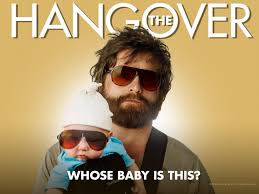
My favourite costume of the day was the bunch of blokes dressed as the guy from The Hangover with the baby strapped to his front. Of course they all had fake babies and by late afternoon the game had become to give the baby a punch if you walked past one of them. The day after I had to try really, really hard to remember not to do that in real life. It would be seen as far less funny.


Truth be told the party itself is far more interesting than the actual rugby, and with the 7 min halves quite often you get distracted and when you next look at the field there are two new teams almost finished their game, quite possibly with another game in the middle you didn't even notice had taken place. Very few people seemed to be there to experience the pinnacle of Sevens Rugby. While the fragments I actually watched were very fast and high scoring, to be honest I think you have to be from the Pacific Islands to really appreciate it. The big guns from both hemispheres are replaced by places like Fiji and Samoa in the global pecking order in this form of the game, which adds a whole lot of unpredictably as to who is going to win. Once you add into in the fact there are at least three tournaments taking place on one field, each with their own trophy and I'll be buggered if I could work out what was supposed to be happening most of the time.


On the Sunday there was a bit more wandering around to see if sitting elsewhere in the stands would work, but most of the seats on the other three sides of the pitch are either corporate boxes/seats of various plushness or non-drinking sections, I guess for people who actually want to watch the rugby or not expose their kids to several thousand rabid fans of being drunk and wearing fancy dress in public. The atmosphere in the stadium was always good, thanks I guess to it being only 40,000 capacity and having big curving roofs on two sides to channel the noise onto the pitch, but I suspect the roar you could hear was mostly coming from the south. It was better to be able to feel that noise splatter right on you and run down your back than it was to hear it from a distance.


Best pitch invasion was the guy dressed in a teddy bear costume who managed to not only evade all security but managed to climb the goal posts and stand on the cross-bar. When you think of how it is to climb goal posts while a) drunk and b) wearing a bear costume then it's highly impressive when you can combine the two.


The nights seem just as big as the days, my trusty Sherpas making sure I managed to get out to the designated drinking zones of Wan Chai and LKF after the matches on different nights to experience the crowds. I remember Hong Kong being far more fun to be out at night in than Singapore in the days I used to go to both for work, but I never remembered it being as packed as it was on the Friday and Saturday nights for the Sevens. One thing I learned about Hong Kong is you can not only buy beer from 7-Eleven and drink it in the street, but you can also take those beers in a taxi cab and drink them on the way. You can even take jugs, though the taxi driver will ask you to not attempt to pour from the jug to the cup while the taxi is in motion. Which is fair enough.


So on this trip to Hong Kong, I did nothing you're supposed to do as a tourist. I didn't climb Victoria Peak, go shopping or visit Macau. Which was exactly what I wanted, because I'd hated to have missed a second of the Sevens. It was with heavy heads we passed through Shenzhen airport on Monday morning into China proper, the result of way too much fun compacted into such a short space of time.


I'll just at this point mention all these China posts came much later than they were actually written due to the fact The Great Firewall of China (GFWoC) blocks most blogging sites and fairly regularly most web-based email as well. The Chinese Government is famously heavy-handed with their attempts to control information and having people being able write whatever gibberish comes into their head kind of goes against that.

Thursday, August 20, 2009

3x3 Animal Style

Redwood City :: USA


I ain't getting out of my damn car for no-one!


Places: San Francisco Bay Area


Coolest thing I did: Found out that there was a whole garden full of Rodin bronzes in the grounds of Stanford University. UTS didn't even have grass.


Coolest thing I didn´t know: You can buy an iPod from a vending machine. You know something is a commodity when you can get it out of the same machine that sells you M&Ms and bottled water.


Due to some wonderful wrinkle in how training gets organised at my company I managed to get myself a 4 day trip out to the San Francisco Bay Area, not knowing I was going on Tuesday and landing on Sunday. It’s pretty easy to say ‘yes’ to these kinds of things on the spot when you don’t have spouses or kids to worry about.


It’s interesting to come back to this part of the world, which was my first taste of America and pretty much how I saw the country in my head for years, a nation completely made up of low-rise office parks and freeways. As a tourist you probably would never venture this far south of the city, except perhaps driving through on your way to Los Angles and to tell the truth you wouldn’t be missing much. Silicon Valley, that stretch of the east side of the bay between South San Francisco and San Jose is what I thought America was. It’s been almost a decade since I first came here, at the height of the dot-com boom when people actually walked the streets with the initials ‘MOP’ on their T-shirts (Millionaire On Paper) and the banks would lend people money against their unvested stock options and right now as a second boom comes to an end (for the whole country this time) the mood is nothing like it was back then. For the second time in 10 years there seems to be some questioning of whether working constantly for the promise of stock that may be worth something by the time you can sell it instead of having a life is a good trade off.


This trip was really too short to spend more than a little time in the fine city of San Francisco itself, having only a single jet-lagged Sunday to be a tourist before having to spend three days in the office. I took the hire car out to Half Moon Bay, where I went to last time I was out here but have since learned overlooks Mavericks, one of the world’s heaviest (in the sense of volume of water, as opposed to 80s surfer talk) waves. The wave breaks offshore, over some rather pointy looking rocks that give it the nickname “the meat grinder” so it’s hard to see but looking before I left on Google Maps I reckoned you could drive right up to the headland and look down on it. The trouble was the day I showed up was completely flat, enticing no surfers out that far and the bluff overlooking it is also a US Air Force missile tracking station, crowned with massive golf-ball antenna. You could kind of see something that might have been waves crashing over rocks, but it wasn’t all that spectacular. It looked better on YouTube. However, it was a very nice afternoon and lunch at the microbrewery set me up well for a long afternoon of trying not to fall asleep at the wheel.


I’d forgotten how stupidly small the micro-climates are, the fact that it could be 30 degrees at the hotel in Redwood City, 25 at Half Moon Bay and 19 and foggy in the city. I decided a good way to stay awake would be to drive up and have another look at the Golden Gate Bridge, because you know, that’s what you do here. By the time I’d driven up to the Presidio, parked the car and walked up to where I should have been able to see it there was fog so think you could consider it a landmark. I then got back in the car, drove under the bridge to the other side and the sky was blue again. Behind me you couldn’t make out the bridge, but the fog seemed to be fairly heavily sticking to it. I imagine if this was the first time you were seeing it you’d be as annoyed as I was when the only time I was in New York they had scaffolding over the Flatiron building and a picture of it painted on a canvas hung over it.


Sydney is a city that is rapidly being rebuilt around the car, however the Bay Area has been like that forever. Bar the inner city of San Francisco itself I have no idea how you’d even attempt to get around on public transport. Having said that, the city is a bit of a nightmare to get around when you’re driving an unfamiliar car, on the wrong side of the road and in serious need of sleep. I kind of decided on skipping all remaining sightseeing opportunities before I got pulled over for drunk driving while sober.


I had made a promise before I left that I would attempt to keep burgers and chips out of my diet for as much as possible, kind of as a challenge. This forced me to dig around in Google a bit for places to eat that weren’t the hotel bar and I got to look at some of the other towns in the Valley, most of the best places I found keeping me returning to Palo Alto and the area around Stanford University. Palo Alto is kind of like a Disneyland version of America in the 1950s. It’s disgustingly clean, the concrete is white, the roads are a contrast of flawless jet tar with perfectly straight lines painted on them. There’s no rubbish, no gum stuck on the footpath and the trees are all identical. While I imagine if you were teleported there from a village in Africa you’d have think you had actually died and gone to heaven I kind of found it a little creepy.


It’s the same kind of creepy that all those perfectly manicured business parks have. The Openwave office is in a complex at the end of 3 miles of salt flats and the port of Redwood City, however it juts out into the bay with its polished glass and exactly 1 inch long lawns. There’s a beach volleyball court, gym, pool, basketball court and countless other leisure activities I can’t quite bring to mind right now because there are simply so many of them. The hotel I stayed in was in a whole bunch of similar parks, EA being right over the road and the imposing towers of Oracle’s headquarters being the first thing you look out over at breakfast. I went running around the place and it was the same thing, lawns that look like they’ve never had touch or soccer played on them, empty basketball courts. It’s like the companies are saying “if you become a fat slob because you’re at work all the time don’t blame us, there’s a tennis court right out the window”. You really do accept that work is going to be your entire life when you come to work on these campuses, and the scary thing is they’ve attempted to export this model overseas. The Sun campus they were building in Surrey while I was working there worked on the same principle, with the only problem being no-one wants to play volleyball when it rains 9 months of the year.


With all this technojiggery going on you forget that long before the nerds spread out from Menlo Park and Stanford all of Northern California was the domain of the counter-culture revolution. Occasionally you’re reminded, like when you’re in a restaurant where steaks are $40 a go and two 60 something ladies are all overjoyed to have just discovered that they are both Virgos. Another time I overheard a slightly younger bunch of high powered business type women have a serious conversation about how someone wouldn’t work on their project team because he was a Sagittarius. I wonder if you can take them to court for unfair dismissal for Zodiac-based discrimination.


When you travel for work and you’re the only out-of-towner you do spend a fair bit of time sitting at bars to eat. At the hotel on the night I checked in there was a wedding going on and occasionally the guests would come out to the hotel bar to jump the queue at the actual wedding bar. Not one of them ordered beer. I think this is why we don’t understand the Americans as drinkers, it’s all those heavy spirits they insist on drinking. No wonder they only have two speeds, sober and drunk – without beer it’s very hard to take a meandering journey towards being blotto. It probably doesn't help that the vast majority of their beer is, as the French would say ‘merde’.


You can do everything in a car here, get coffee, pick up your dry cleaning, even get money out of the ATM. Add to this the fact that McDonalds are currently advertising a 1/3rd pounder (no, really) and the mystery of why the average American is large than the average Frenchmen becomes apparent. Having said that, I did break my no fries rule for my last meal on this trip in order to experience In-N-Out Burger. It’s a California-only burger chain with practically nothing on the menu. You can have a cheese burger or a double cheese burger. Unless you know the secret code. One of the guys in the office told me to go in and ask for a 3x3 Animal Style with Onions. It’s as wonderfully filthy as it sounds and I suspect I might be skipping the first 2 meals on the flight back. Any chain that lets you pick the exact beef patty:cheese ratio on your burger is strictly for the discerning, you won’t get that happening at Burger King.


So my one real cultural experience came by accident. During one of my crazy awake-at-strange-hours-of-the-morning periods I was flicking through the supermodel-thin guide to the highlights of being a tourist in the San Jose area. Wedged in between the descriptions of restored historical down town areas and shopping centres (which apparently double as tourist attractions here) I saw that Stanford University has a whole garden full of Auguste Rodin bronzes, including his famous Gates of Hell, the original backdrop for The Thinker. I've managed to see quite a few of these before around the traps (most notably at the Rodin Museum in Paris) but they're always pretty good and there's something different about seeing them outside in that soft Californian light, totally different to mid-winter London or Paris. Some people get a bit annoyed to discover that Big Rodes' (as he was known to his mates) work was copied fairly liberally and there are actually several copies of the big name works like The Thinker or The Burghers of Calais (which I personally like better) around the various art galleries of the world, like they aren't looking at the original but "just a copy". You get the same thing with Edvard Munch's The Scream but I guess both these dudes came up at a time where mass production was already the norm in industry and publishing, so why not art? Big Rodes was a genius full stop and it's always pretty damn cool to see his stuff out in a park somewhere. You miss that kind of stuff in Australia.

Saturday, February 14, 2009

Leaving London

London :: UK


The Home Office decides it's time for me to go home.


Places: London


Coolest thing I did: Spent the last night living it up in the Waldorf. It's been a long time since I stayed somewhere and been called 'sir'.


Coolest thing I didn´t know: London can still snow like it's 1991. I personally blame global warming.


It’s somehow fitting for your last day in London of have the soggy consistency of a chewed up cigar butt. If you averaged out the weather in London whilst I’ve been living in the city then cold, constant drizzle would probably be the closest possible. In a week that saw a couple of days with weather more suited to Switzerland than the South East of England it was a better reminder of the time here. Luckily, I was never here for the weather.

In both the weeks I’ve been back here (with the exception of that week out in The Real England) I’ve spent a fairly large chunk of my time wandering around various parts of the city and looking back through the photos on my camera I have been muy touristico. That was never my intention, I guess now that I’m faced with the fact that I will very likely not be back to this city I’ve called home on and off for almost a decade I wanted to just get out and feel the texture of it under my feet again. I don’t doubt I’ll be back one day, as this place has had a disproportionate effect on who I am, but I might be quite old by then.

I have actually been surprised at the places I’ve ended up, some of which I never thought necessary to visit even when I was last living here. The jaunt through the pubs around Hammersmith and Brook Green opened up a whole lot of important memories for me, as the year I spent living in an over-crowded house of Aussies on Blythe Road was probably one of the happiest years of my life. Even though it’s gentrified out of sight in Ws 6 & 12 in the intervening 6 years the memories still lurk around every corner, just waiting to jump out at you. I imagine walking around Dublin or Toronto would be very similar experiences.

The Mayor of London recently likened reading the Financial Times to spending an hour with a doomsday suicide cult and you do get a far greater feeling of depression here than has been true watching the collapse of global finance from the warmth of a Sydney summer. Walking down from Liverpool Street into the heart of the city feels a bit like visiting the ruins of a defeated empire, some of the flashier bars and restaurants are empty, even on Thursday lunchtime. Some are even shuttered for good. That’s not something you would have seen a couple of years ago. Even if it is just a mood, something that may not be reflecting the actual facts you do feel the London of the Russian Oligarchs and the Hedge Fund managers may have been and gone, with what’s replacing it more suited to grey skies and cold rain. I’m still waiting to watch them burn the chairmen of HBOS and Barclays at the stake at Charring Cross, but I might have to leave before that happens.

The fact I’m thinking like this makes me believe I’ve been watching the BBC too much since I got back.

As I said, I was never here for the weather. London over the last decade has been incredibly good to me, and through my tastes in nightlife may have morphed from Walkabouts and super clubs to gastropubs and proper food this is a city that still has a variety that hasn’t been matched by practically any other city I’ve been to (the only possible exception being New York). No matter what you’re into, be it art, culture, nightlife, food, poetry readings, whatever it’s possible to find it here. (OK, I admit if you’re into wind surfing that may be a bit of a stretch…). If I have one complaint to make about returning to Sydney over the last 6 months it’s been how completely stagnant it feels, as if no one has had an idea and opened a new pub or restaurant in the last 5 years. I know that’s not 100% fair, but compared to how constantly shifting London’s scene is Sydney may as well be the same as it was when I was at Uni.

Visitors to this great city often go looking for the traditional, trudging around in the grey rain, looking at grey buildings, eating grey food and drinking warm beer. You know, in search of The REAL London. The trouble is, the real London for me is the living one, the one that can accommodate both the British Museum and a tiny gallery in Bethnel Green displaying pictures of pierced eyebrows to the sound of whale song. That’s the same London that can serve up fish and chips in a pub that hasn’t seen a lick of paint since the 1940s as one that dishes up food from every country in the world, and some that are found nowhere else and quite often at prices found nowhere else. It’s the same city where you can find old me in flat caps grumbling about football into their pints of warm beer in a pub named after the head of some dead royal right around the corner from private clubs filled with mass produced Eastern European models still angling for a partner from that rapidly shrinking pool of bonus-fuelled City boys. It’s simply a city like no other, one you couldn’t re-create if you tried.

This is why I’m in two minds about my Home Office-incompetence-enforced exile from this great land. This city has been very good to me, offering me somewhere ever impressive to live combined with the money and location to travel far beyond what I could have achieved had I never left Sydney. I’ve always maintained that I’d always return to Sydney one day, but the trouble is, that one-day has always been at least 12 months down the road. Perhaps this is that push I may have required to try my hand back in Australia again, to see if am just calling Sydney home out of habit or if that’s where I really belong. It’s hard to see how it would have happened otherwise. I guess we’ll have to see what tune I’m singing if the Home Office do actually turn around and grant me a work permit after all, whether I’m tempted back.